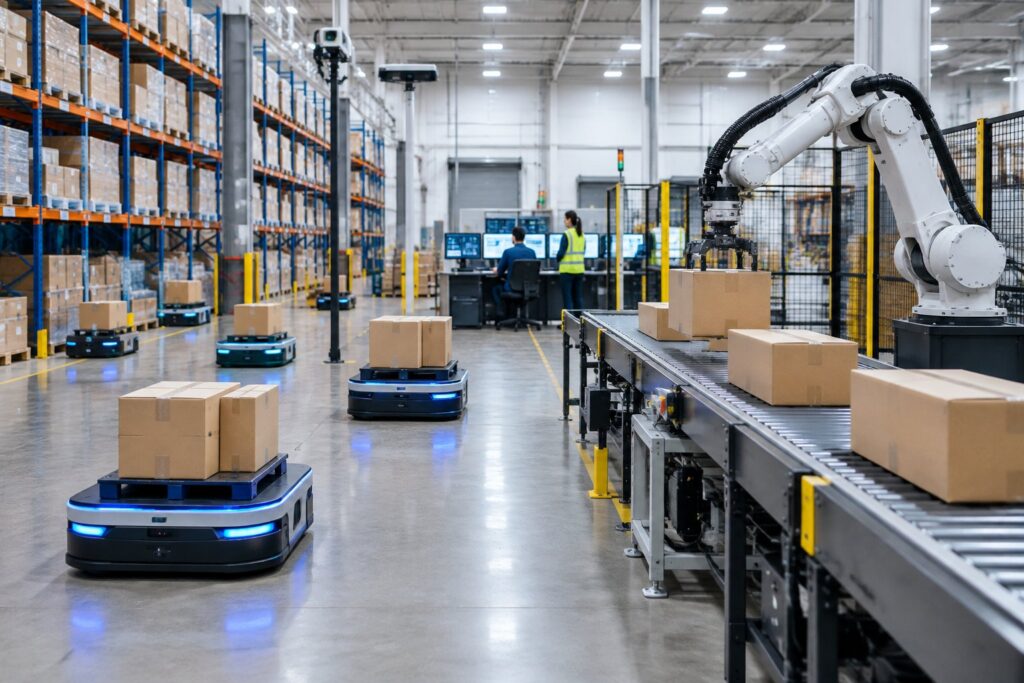
Tailored digital employees are AI-powered teammates built around your business workflows, using company-specific instructions and connected tools to complete tasks within defined permissions. At Wise Agents, we design, build, and run these digital employees for mid-market businesses, including manufacturers, distributors, and logistics companies that want to reduce manual work inside existing systems.

A request for a quote involves reading an email, identifying products, checking availability, applying pricing rules, and following up. A digital employee connects those steps into a controlled workflow, with people reviewing exceptions and consequential decisions.
Our approach starts with a measurable operational problem. You keep your ERP, CRM, and other business applications while we tailor the digital employee to the process your team needs to complete.
What Makes a Digital Employee Tailored to Your Business?
We consider a digital employee tailored when its instructions, knowledge access, and permitted actions reflect your actual operating process. That includes your approval thresholds and the conditions that require a person on your team to step in.
How Do Digital Employees Turn Business Instructions into Actions?
A digital employee combines an AI model with instructions and tools. The model interprets incoming information, selects an appropriate next step, and requests a tool action within the workflow’s boundaries.
For a quoting process, we translate operating procedures into explicit steps: extract requested items, check product records, retrieve approved pricing, and prepare a quote. Connected software executes the authorized actions and returns results for validation.
We recommend enforcing critical business rules in application logic as well as instructions. A pricing tool should reject a discount outside the approved range even if the model requests it.
How Do Digital Employees Differ from Chatbots and AI Assistants?
We distinguish these systems by their operational responsibility. A scripted chatbot follows predefined conversation paths, while general-purpose AI assistants help people answer questions or prepare content.
A digital employee owns a defined outcome across multiple steps. An order-processing digital employee, for example, checks required fields, retrieves account details, and creates an approved record through connected tools.
The categories overlap because some assistants also support tool use. When evaluating any AI system for operational work, we recommend asking which actions it performs, how it verifies completion, and where its authority ends.
Which Tasks Need Human Approval?
We recommend approval gates for actions with financial, legal, safety, or customer-relationship consequences. Examples include releasing payments, accepting contract changes, issuing unusual credits, and making delivery commitments outside approved rules.
Approval should attach to a specific proposed action. The reviewer needs the supporting records, relevant policy, and expected effect before authorizing execution.
Routine actions fit a different permission level. Reading order status or preparing an internal draft requires less authority than changing an account’s payment details, so we recommend separating those tools and credentials.
Which Business Workflows Can Digital Employees Take Over?
Our strongest workflow candidates involve recurring work that crosses applications and includes emails or documents requiring interpretation. We focus on processes with identifiable inputs, explicit completion criteria, and an exception path.
Quoting and Order Processing from RFQ to Delivery
Our quoting automation supports a pipeline from RFQ intake through delivery. A digital employee processes an incoming request, extracts line items, and gathers the information needed to prepare a quote.
Connected tools retrieve customer records and approved pricing. Missing specifications or ambiguous product matches go to the right person on your team before the workflow proceeds.
After acceptance, the process moves into order creation and downstream coordination. We recommend tracking quote turnaround time alongside correction rates so faster preparation stays tied to order quality.
Procurement, Inventory Replenishment, and Production Scheduling
We build digital employees that support procurement and coordinate replenishment using information from connected business systems. The workflow evaluates stock availability and purchasing requirements before preparing an authorized next action.
For production scheduling, the digital employee’s role should reflect the planning system’s capabilities. It gathers constraints and coordinates updates while scheduling software performs the required calculations.
We recommend keeping explicit controls around supplier selection and purchase commitments. A shortage alert might trigger a purchase requisition automatically, with approval required before a purchase order is released.
Shipment Tracking, Billing, and Customer Communication
Shipment workflows give a digital employee a concrete coordination task: retrieve status, identify exceptions, and communicate verified updates. Our digital employees connect these activities with order records and customer communication channels.
Billing workflows also benefit from structured checks. A digital employee compares available order and delivery information, prepares billing records, and routes discrepancies for review.
We recommend keeping customer-facing statements tied to confirmed system data. A carrier’s estimated arrival should stay labeled as an estimate, and conflicting shipment records should trigger investigation before a firm commitment is sent.
Grain Ticket Matching and Real Estate Lead Follow-Up
Our agriculture and agribusiness workflows include processing grain tickets and matching contracts. These tasks require careful handling of document fields, units, and identifying information before a match is accepted.
We recommend explicit exception rules for incomplete tickets or multiple plausible contract matches. A review queue should show the original document beside the extracted information.
In real estate, our digital employees handle lead follow-up and book showings. The workflow uses approved property information and scheduling access, with communication rules governing outreach and escalation.
Analytics, Admin, Outreach, and WhatsApp
Our digital employees also cover work outside the core supply chain flow. An analytics digital employee monitors your data continuously and surfaces the insights that matter, without anyone pulling a report. An admin digital employee takes on time-consuming administrative work so your team can focus on what drives revenue.
An outreach digital employee finds contacts, writes personalized emails, and follows up automatically, and your team steps in when someone is ready to talk. Our newest digital employee works through WhatsApp.
How Are Digital Employees Built and Connected to Your Systems?
We build digital employees by combining model reasoning with controlled data access and reliable tool integration. The architecture should follow the workflow’s requirements, including its response-time targets and operational risks.
Choosing Models for Accuracy, Speed, and Cost
Large language models (LLMs) interpret requests and select tools, but the right model depends on the task. We test each workflow on representative business records before choosing among models such as Claude, OpenAI’s models, or Meta Llama.
We start with a capable model to establish an accuracy baseline. Then we evaluate smaller models for simpler work, such as routing an email, while keeping stronger reasoning where exceptions require it.
Large language models should also work alongside deterministic software. Pricing calculations belong in validated calculation tools, and structured outputs should pass schema checks before reaching a business system.
Grounding Work in Business Knowledge and Memory
Retrieval-augmented generation supplies relevant business information at the time of a request. The digital employee retrieves approved material, such as a current procedure, and uses that context when preparing its response or action.
We recommend treating authoritative records and the digital employee’s memory as separate resources. An ERP holds current inventory; memory keeps useful workflow context, such as which missing document has already been requested.
Persistent memory needs ownership and retention rules. A remembered customer preference should never override an updated account record, and access restrictions must apply to retrieved information as well as stored context.
Connecting ERP, CRM, and Email Through APIs and MCP
APIs let a digital employee retrieve information and request changes through controlled interfaces. Our integrations include Oracle NetSuite, SAP S/4HANA, Syspro, Epicor, Coupa, SAP Ariba, HubSpot, QuickBooks, Xero, and Outlook.
Model Context Protocol (MCP) standardizes how compatible applications discover and invoke tools. An MCP server exposes capabilities as MCP tools, such as finding an order or creating a draft record.
We recommend evaluating each connector’s authentication and permission boundaries. MCP provides a connection standard; the underlying service still needs authorization checks and input validation.
Reliable execution also requires duplicate protection. If a connection times out after an order is created, a retry should check for the existing record before attempting another creation.
Why We Run Digital Employees as a Managed Service
Keeping a digital employee reliable is ongoing work. Integrations change, business rules evolve, and models get updated. That is why we design, build, and run every digital employee for you on Wise Infrastructure, our platform built for deploying digital employees quickly and reliably.
Every digital employee also needs deployment controls and an operating owner on your side. We handle the technical side; your team owns the process and the approval rules.
Splitting work across several specialized digital employees becomes useful when responsibilities need separate tools or evaluation criteria. We recommend starting with one digital employee and adding coordination only when the workflow justifies the additional complexity.
Our managed service covers design, construction, and ongoing operation of your digital employees. We require no coding or technical knowledge from your team, while your business owners provide process knowledge and approve the operating boundaries.
What Does a Production-Ready Deployment Require?
We treat production readiness as a combination of verified workflow performance and controlled execution. A deployment needs documented permissions, operational monitoring, and a clear route back to human handling.
Workflow Discovery, Scope, and Success Criteria
Our Discovery Agent maps workflows, recommends suitable digital employees, and turns findings into a proposal. Discovery should establish where work begins and what counts as a completed transaction.
We recommend collecting representative examples, including rejected requests and unusual documents. These reveal requirements that a written procedure may leave out, such as how your team resolves conflicting product identifiers.
Success criteria should include a quality measure and an operational measure. For order intake, those might be accepted-record accuracy and median processing time, with a named owner responsible for approving launch.
Permissions, Human Review, and Data Protection
We recommend beginning with read-only tools where the workflow allows them. This supports validation of retrieval and interpretation before granting permission to update production records.
Write access should follow least-privilege principles. Separate service accounts, restricted tool scopes, and approval gates limit the effect of an incorrect action.
Our Wise Infrastructure includes observability, audit trails, governance controls, and human review options. We are SOC 2 certified, GDPR compliant, ISO 27001 compliant, and Vanta certified for continuous compliance monitoring.
Testing, Monitoring, and Ongoing Operations
We recommend testing complete transactions, including failure paths. A production test set should cover missing data, conflicting records, expired credentials, duplicate requests, and unavailable systems.
External emails and documents also require prompt-injection defenses. Instructions embedded in incoming content must stay separate from the rules governing tool use and data access.
Monitoring should record tool calls and their outcomes without unnecessarily exposing sensitive content. Useful operational measures include completion rate, exception frequency, and cost per accepted transaction.
An operating plan also needs a pause mechanism and a fallback owner. We recommend rerunning evaluations after changes to models, instructions, connectors, or business policies.
Deployment Timelines, Cost Drivers, and ROI
Our typical deployment takes 4–6 weeks. Access to required systems, representative records, and timely stakeholder decisions influence how that schedule progresses.
We recommend planning discovery and integration work before launch testing. A workflow that reads one mailbox has a different implementation burden from one that writes to several ERP entities and routes approvals across departments.
Cost drivers include document complexity, integration scope, transaction volume, and ongoing support. Model usage is one component of the operating expense.
For ROI, we recommend comparing annual benefits with total annual costs:
ROI = (annual benefits − annual costs) ÷ annual costs × 100
Count labor capacity savings only where automation reduces hands-on work. Include review time and exception handling in the calculation, and validate any claimed revenue benefit separately.
Start with One Workflow and Scale What Works
We recommend starting with one tailored digital employee assigned to a recurring process with measurable outcomes and a clear business owner. A bounded quoting or order-intake workflow gives you a practical basis for assessing quality before extending permissions.
Establish the baseline, approve the review rules, and compare accepted results after launch. Expansion should follow evidence that the digital employee completes work reliably within those boundaries.
Our Agent Sandboxes let you try our digital employees hands-on, and our Discovery Agent helps map a suitable workflow. To discuss a specific process, contact us at info@wiseagents.com with the systems involved and the manual steps you want to automate.
Frequently Asked Questions
We approach tailored digital employees as teammates for defined business tasks, with scope and responsibility established before deployment. These answers address the practical purchasing and implementation questions prospective customers raise.
How much does a tailored digital employee cost?
We scope pricing around the workflow’s integration requirements and operating workload. When comparing proposals, ask for separate implementation and recurring costs, including model usage, monitoring, and support.
Do we need technical staff to run a digital employee?
No. We design, build, and run every digital employee for you, so your team needs no coding or technical knowledge. Your business owners explain how the process works and approve the operating boundaries.
Can a digital employee work with our existing ERP and CRM?
Yes, we connect digital employees with existing ERP and CRM platforms, including Oracle NetSuite, SAP S/4HANA, and HubSpot. During scoping, we verify the required data access and permitted actions for your specific configuration.
Does a tailored digital employee need to be trained on our business data?
No. We build business-specific behavior using instructions, retrieved knowledge, and connected records, without training a model from scratch. Current operational facts always come from your authoritative business systems, such as your ERP or CRM.
How long does it take to deploy a tailored digital employee?
Our typical deployment takes 4–6 weeks. We confirm the project schedule after mapping the workflow and checking integration access, with your team providing process guidance and approval decisions.