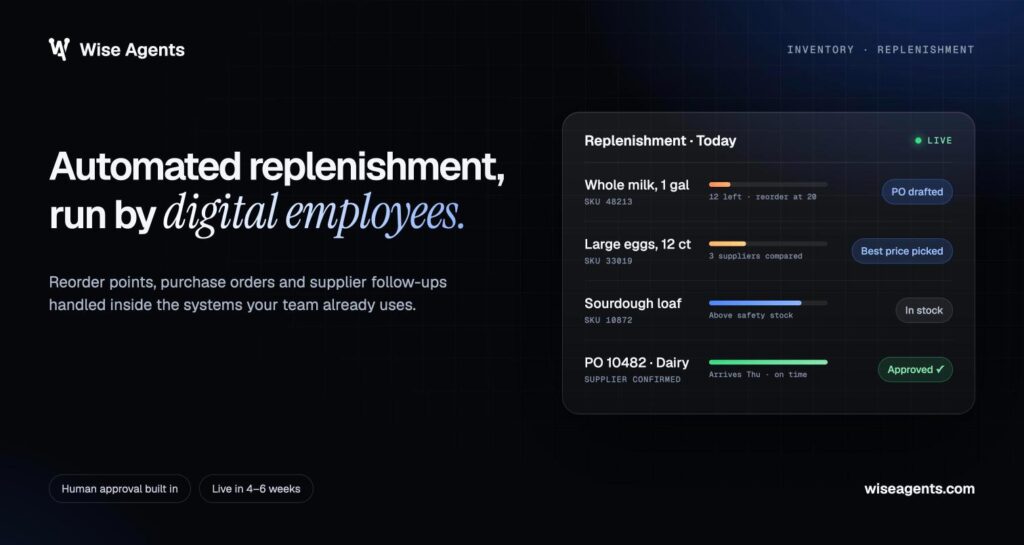
AI in procurement helps teams turn purchasing requests, supplier messages and transaction records into structured work, faster follow-ups and reviewable recommendations, with people approving purchase commitments. For mid-market supply chain companies, practical starting points include RFQ preparation, replenishment planning and purchase order checks that reduce repetitive buyer work.

At Wise Agents, we design, build and run digital employees inside the systems your team already uses. In procurement, the goal is simple: give buyers time back and keep every purchasing decision with the people responsible for it.
The benefits of AI in procurement become measurable when automation completes a defined workflow. A useful result is a complete RFQ ready for approval, or an invoice discrepancy routed with its supporting records, so your buyers always know the next action. For a step-by-step view of one high-volume process, see how an invoice processing workflow runs from email capture to ERP posting.
Where Can AI Help Across the Procurement Process?
AI works best on information-heavy procurement workflows where the inputs, the expected output and the decision owner are clear. Across source-to-pay and procure-to-pay, the strongest opportunities connect document handling with system records and accountable review.
SKU Analysis, Demand Forecasting and Replenishment Planning
SKU analysis connects item-level purchasing decisions with inventory management. Relevant inputs include available stock, open orders, consumption history, supplier lead times and reorder points. Before using predictive analytics, your team should clean up duplicate item records and inconsistent units of measure.
Demand forecasts need to be compared against actual consumption and your existing planning method. We recommend keeping forecast recommendations separate from approved replenishment quantities, especially for seasonal demand or intermittent-use parts. Buyers should see the assumptions behind each recommendation, including the lead time and demand period used.
Purchase Requisitions, Purchase Orders and Approval Routing
Incoming purchase requisitions should be structured before they enter the approval queue. A digital employee identifies the requested item, quantity, required date and relevant business details, then asks for anything missing. Policy rules decide which approver receives the completed request.
Purchase order preparation should use approved supplier and item records. The workflow should keep the requisition reference and show any changes made during review. Releasing the order always requires approval from an authorized person.
RFQ Preparation, Supplier Selection and Follow-Ups
A procurement digital employee can review incoming quote requests, identify missing information, prepare RFQ drafts, match suppliers and track their responses. A simple tracking view gives purchasing managers visibility into request status, prices received, missing items and next actions.
For supplier selection, compare bids on a consistent basis. Normalize quantities, units, freight assumptions and delivery requirements before ranking offers. Supplier evaluations should keep the qualification evidence so a buyer understands why a supplier made the shortlist.
Follow-up sequences should stop as soon as a supplier responds or a buyer takes over. That prevents duplicate outreach and protects supplier relationships while keeping unanswered requests visible.
Supplier Confirmations, Delivery Dates and Performance Tracking
Supplier confirmations should be captured against the right purchase order and line item. The workflow should separate the requested delivery date from the date the supplier confirmed. Any change needs its source message and timestamp attached.
Supplier performance tracking only becomes useful once your team agrees on the measurement rules. For example, measure on-time delivery against a defined commitment date and treat partial shipments the same way every time. Supplier relationship management then has a reliable record for performance conversations and sourcing decisions.
Invoice Data Extraction and PO-Invoice-Receipt Matching
We recommend combining invoice data extraction with fixed matching rules. The extraction step reads invoice fields and line items; the matching step compares them with purchase orders and receiving records. Exact calculations should apply your approved tolerances.
Three-way matching needs clear handling for partial receipts, freight charges, taxes and unit conversions. Anomaly detection should flag unusual records for review, including possible duplicates. A missing receipt should go to an exception queue with the related documents attached.
Spend Analysis, Strategic Sourcing and Contract Review
Spend analysis gives you a consistent view of suppliers and purchasing categories. It should merge supplier name variations and separate invoiced amounts from open commitments. That improves spend visibility for category management and strategic sourcing.
AI in sourcing supports research, bid comparison and negotiation prep. Sourcing recommendations should show their evaluation criteria and evidence. Buyers stay responsible for award decisions and commercial trade-offs.
For contracts, automated analysis can pull out obligations, renewal dates and key clauses, compare them with approved requirements and flag deviations for legal or commercial review. Contract improvements start with validated findings, such as an upcoming renewal or a gap between negotiated pricing and what was invoiced.
Which Procurement AI Capabilities Fit Your Workflow?
Choose procurement AI capabilities based on the work your team needs done and the systems that hold your official records. Reading documents, forecasting and validating transactions each call for a different approach.
What Machine Learning, NLP and Generative AI Actually Do
Machine learning finds patterns in historical data for tasks like demand forecasting or spend classification. How useful it is depends on representative data and on checking it against actual outcomes.
Natural language processing (NLP) interprets the text in supplier emails, RFQs and contracts. Generative AI produces drafts and summaries from that information. Keep source references and require review whenever generated wording affects specifications or commercial terms.
How Digital Employees Differ from Rule-Based RPA
Digital employees handle coordinated work across documents and business systems. A digital employee can interpret a task, choose the permitted steps and carry them out within defined boundaries. In procurement, that includes gathering missing information and preparing a review packet.
Robotic process automation (RPA) runs predefined actions, such as moving approved fields between stable screens. It is a separate approach from AI. The strongest designs combine language understanding with fixed rules for calculations, permissions and approval thresholds.
Procurement Software with Built-In AI vs. a Managed Digital Employee
Procurement platforms with built-in AI and managed digital employees solve different problems. A platform gives your team an environment for purchasing activity. A managed digital employee is designed and operated around one of your specific workflows.
| Criterion | Procurement Software with Built-In AI | Managed Digital Employee |
|---|---|---|
| Starting point | Platform capabilities | Your defined workflow |
| Workflow setup | Your team or an implementation partner | The provider |
| Ongoing operation | Run by your team | Run by the provider |
| Improvement over time | Product and configuration updates | Ongoing reviews with your team |
Our tailored digital employees suit workflows that need coordinated work across the systems you already have. We design, build and run them, so your team doesn’t need coding or technical knowledge.
What to Check About Integrations with Your Current Systems
A procurement digital employee works inside the systems you already run, such as your ERP, procurement platform and accounts payable tools. Even so, the scope of each connection needs to be confirmed workflow by workflow. A connected system doesn’t automatically mean access to every record or action.
Your integration review should identify the system of record for supplier data, inventory and purchasing transactions. Confirm read and write permissions, sync timing, duplicate prevention and recovery after a failed update. Your ERP should only receive validated changes within the approved scope.
How Do You Keep Purchasing Decisions Under Human Control?
Use explicit approval gates, restricted system access and traceable exception handling. These controls connect faster processing with the financial and operational responsibilities of supply chain management.
Require Human Approval Before Releasing Purchase Commitments
Require human approval before any purchase commitment is released. The approval packet should include the proposed supplier, quantities, commercial terms and supporting evidence. Your authorization matrix decides who can approve each commitment.
The workflow should pause while approval is pending and record the approver’s decision. Price or quantity changes after approval should trigger another review. Approval rules belong in the workflow’s permissions, not just in instructions.
Route Missing Data, Price Mismatches and Delivery Exceptions
Send each exception to a named owner with a clear reason for review. Missing specifications go to the requester or buyer; a price mismatch needs the related PO and supplier document. Delivery exceptions should include the affected order lines and the current commitment.
The exception queue should show status, age and the next required action. Your team should also set escalation timing for unresolved issues. That keeps incomplete work from disappearing into a shared inbox.
Protect Supplier Data and Keep Access Traceable
Give each digital employee access only to the records and actions its workflow needs. Privacy reviews should cover confidential pricing, supplier banking details and personal contact information. Your IT and security owners should approve the access scope.
Every action should be observable and logged. In a purchasing workflow, the audit record should connect the source document to the extracted fields, the reviewer’s decision and the resulting system update. Retention rules and access reviews belong in the deployment plan.
Validate Supplier Risk Signals and Sourcing Recommendations
Treat supplier risk monitoring as an evidence-gathering workflow with a clear decision owner. An external alert should include its source, date and the supplier it refers to. Reviewers should confirm the match before acting.
Supplier risk management also needs context about how dependent you are on a supplier and what alternatives exist. A signal of financial trouble or possible supply disruption should trigger investigation and contingency planning. Sourcing recommendations should show their criteria so reviewers can catch outdated evidence or biased assumptions.
How to Deploy a Procurement Digital Employee
A good procurement deployment moves from discovery to design, a supervised launch and continuous improvement, always organized around one measurable operational outcome.
Map One High-Impact Workflow
Start by mapping how work moves through your team today and where the delays are. For sourcing and procurement, pick a recurring workflow whose bottlenecks are already visible to everyone.
Document what starts the workflow and what counts as done, along with the systems involved, the types of exceptions and who owns each decision. That gives your procurement strategy a concrete first target.
Design System Connections, Responsibilities and Approval Rules
Design the workflow around how your operation already runs. Identify which systems provide the information and which approved actions the digital employee is allowed to take. Procurement, finance and IT should agree on those boundaries.
Keep responsibilities explicit throughout. A buyer owns sourcing judgment, an authorized approver releases commitments, and a named owner handles each exception type. Guardrails and human review steps are part of the design from day one.
Move from Configuration to a Supervised Launch
The timeline depends on how complex your systems are, how clean your data is and how much IT time is available. Starting with one well-defined workflow is the fastest path to a reliable result.
Launch under supervision using representative transactions and known exceptions. Reviewers should check document extraction, approval behavior and system updates before the scope expands.
Support Adoption and Improve Through Regular Reviews
Review performance regularly after go-live. Those reviews connect operational results with adjustments to the workflow. Useful topics include exception volume, how often buyers need to step in and any incomplete transactions.
Change management should make the new responsibilities clear to everyone who touches the process. Your team needs to know how to review outputs, correct a record and escalate a problem. Recurring errors are the best input for improving the workflow.
How Do You Measure Procurement ROI Without Overstating Savings?
Measure procurement ROI by comparing a documented baseline with validated results and the full cost of delivery. A procurement leader should be able to tell financial savings apart from released capacity and estimated risk reduction.
Baseline Buyer Hours, RFQ Turnaround and Exception Rates
Set the baseline before configuration starts. Measure buyer handling time separately from total RFQ turnaround, because waiting on a supplier is not the same as active buyer work. Record transaction volumes and exception rates over a representative period.
Use the same start and end events for each measure. For example, RFQ turnaround might run from receiving a complete request to delivering a review-ready comparison. Keep incomplete requests visible so changes in intake quality don’t distort the result.
Separate Released Capacity from Cash Savings
Released capacity is time your team can spend on other work. If automation reduces admin effort, those hours can go to supplier negotiations or a higher request volume. Cash savings require an identifiable drop in spending.
Validate purchasing savings with finance against an agreed baseline. Keep cost avoidance and modeled risk reduction in separate categories, and don’t count the same improvement twice.
Account for Implementation, Operating Costs and Adoption
Your business case should include implementation, ongoing operating costs, usage-based charges and the time your own team puts in. Adoption determines how much volume actually gets the benefit, so estimates should reflect the share of eligible work that enters the new process.
A simple way to calculate net ROI:
ROI = (validated benefit − total project cost) ÷ total project cost × 100
State the time period and which benefit categories are included. Payback calculations also need a clear cost basis.
Use Actual Performance to Decide When to Expand
Set expansion criteria before the first workflow goes live: output accuracy, turnaround, exception handling and how much buyer intervention is needed. Financial results should be based on observed volume and real adoption.
Compare results with the original assumptions during reviews. If the workflow needs frequent corrections, fix the causes before adding more sites or categories.
Start with One Measurable Procurement Workflow
Start with one recurring procurement workflow that has accessible data, a clear approval owner and a measurable finish line. RFQ preparation and supplier follow-up are strong candidates when buyers spend a lot of time gathering information and chasing responses.
Define the baseline, purchasing authority and exception path before launch. We design, build and run the digital employee around those requirements and keep improving it with your team. For your first scope, write down one trigger, one finish line and the person who approves the result.
Frequently Asked Questions
Which procurement tasks should a mid-market company automate first?
Start with repetitive, reviewable tasks such as RFQ intake, missing-information checks or supplier follow-ups. Choose a workflow with enough recurring volume to measure buyer time and turnaround before and after.
Can a procurement digital employee work with our existing ERP?
Yes. A digital employee works inside the ERP and tools you already use. During design, the records, permissions and approved actions for your specific workflow are confirmed before anything goes live.
Can AI match purchase orders, invoices and goods receipts?
Yes, with the right setup. Use AI to extract and normalize document data, then fixed rules for PO-invoice-receipt matching. The workflow needs receiving records and defined tolerances, with mismatches sent to an authorized reviewer.
Will AI replace procurement staff?
The goal is to free buyer capacity and speed up quote turnaround. Digital employees take on recurring admin work while people supervise the results and keep purchasing authority.
How long does it take to deploy a procurement digital employee?
It depends on the workflow, the number of systems involved, data quality and IT availability. Starting with one clearly defined workflow is the fastest way to get a reliable result.