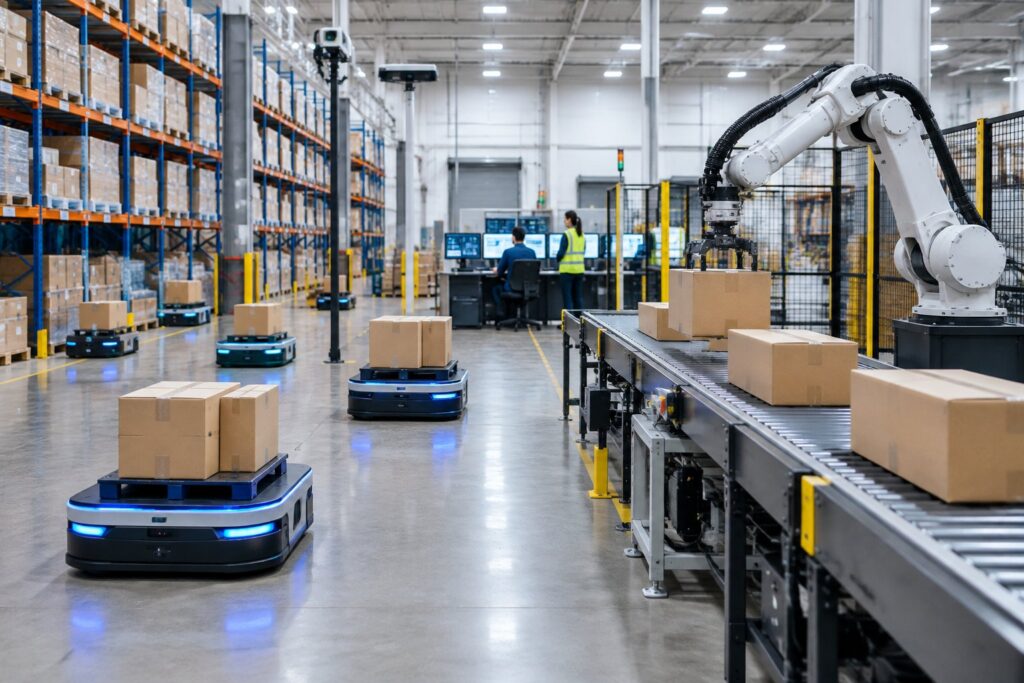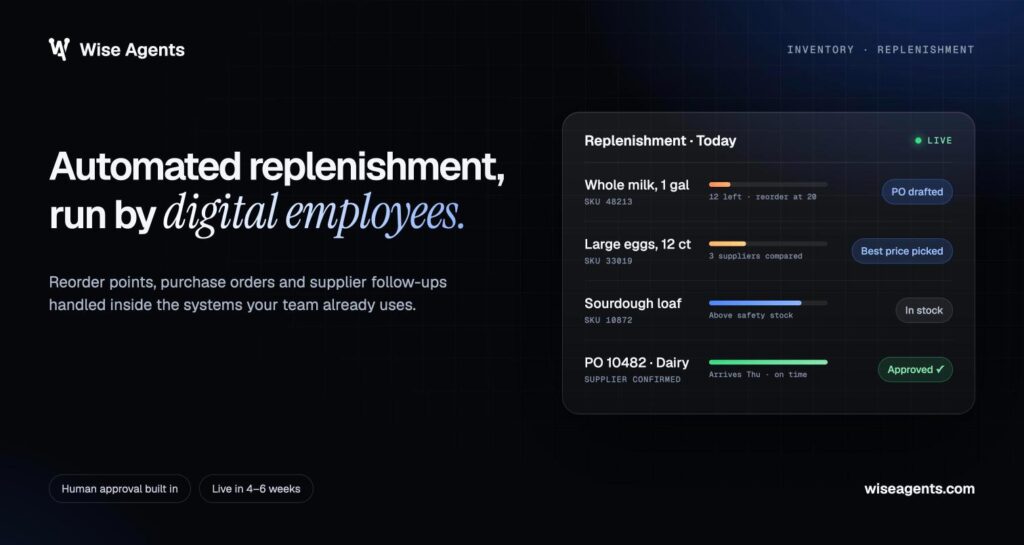
Automated replenishment uses software to monitor inventory and demand, calculate restocking needs, and generate purchase orders or stock transfers under defined approval rules. It helps you reduce stockouts while controlling the overstock that ties up cash and warehouse space.
Our recommendation is to begin with a controlled inventory replenishment workflow: reliable stock records, product-specific ordering policies, and human approval for exceptions. That gives your team a practical way to shorten routine purchasing work while retaining authority over spending and supply risk.
How Does Software Turn Inventory Signals Into Replenishment Orders?
We structure an automated replenishment system around a closed loop that connects inventory signals to approved supply actions and confirmed receipts. Reliable automatic replenishment requires current inventory positions and clear ownership when replenishment workflows encounter exceptions.
What Makes Replenishment Automated Rather Than Just an Alert?
An alert tells someone that a threshold has been crossed. An automatic replenishment system also calculates the requirement and creates a purchase order or transfer request, with approval routing where required.
We recommend defining the automation boundary explicitly. Your auto replenishment workflow might prepare orders for buyer approval initially, then release eligible routine orders after validation. Record which steps run automatically and which decisions remain with your team.
Connect Demand Signals, Inventory Positions, and Open Orders
The replenishment system needs a consistent view of usable stock and outstanding demand. We recommend reconciling sales or consumption with receipts, reservations, returns, and open supply orders at the SKU-location level.
A useful starting calculation is:
Inventory position = usable on-hand inventory + eligible inbound supply − outstanding demand
Apply consistent definitions to avoid subtracting the same commitment twice. Real-time inventory also needs a freshness rule: if an inventory feed stops updating, pause affected orders and route an exception before stale inventory levels trigger purchases.
Apply Reorder Points, Safety Stock, and Supplier Lead Times
Reorder points establish when supply action should begin. For a basic continuous-review policy:
Reorder point = expected demand during replenishment lead time + safety stock
We recommend measuring lead time through the point when goods become usable, including receiving and inspection where applicable. Safety stock should reflect uncertainty in demand and supply, with different service targets for critical materials and low-priority products. Review those assumptions when supplier performance changes.
Calculate Quantities and Generate Purchase Orders or Stock Transfers
Once a trigger fires, the system calculates the quantity required by the selected policy. Under an order-up-to approach, the starting quantity is the target inventory position minus the current inventory position, bounded at zero.
We recommend applying purchasing constraints before order creation: case packs, minimum order quantities, storage capacity, shelf life, and spending limits. Check eligible stock at other locations before buying additional supply. Purchase orders and stock transfers should retain the demand calculation that justified them.
Coordinate Suppliers, Confirm Receipts, and Route Exceptions
Order creation starts the execution phase of the inventory replenishment process. Supplier acknowledgments and promised delivery dates need to flow back into the plan so late supply does not remain counted as available on schedule.
Our approach to AI in procurement includes digital employees that prepare RFQs, track supplier responses, and support follow-up. For replenishment, we recommend closing the loop with actual receipts and routing shortages, damaged goods, price changes, and missed confirmations to named owners.
Which Replenishment Method Fits Your Inventory?
We recommend matching replenishment policies to each product’s demand behavior and supply constraints. Inventory planning works best when stable items use transparent reorder thresholds and seasonal ranges receive forward-looking demand calculations.
Min/Max Rules for Replenishing Between Stock Limits
Min/max stock replenishment triggers action when the defined inventory measure reaches its minimum and orders enough to restore the maximum. It suits repeat-use supplies and products with relatively stable consumption.
We recommend setting limits by SKU and location. A single company-wide maximum ignores differences in sales velocity and available space. Reassess both limits when case packs change or an item begins accumulating excess stock.
Reorder Point Policies for Lead-Time Demand
A reorder point policy ties the ordering trigger to expected consumption before replacement stock becomes available. The order quantity follows a separate rule, such as a fixed lot size or an order-up-to target.
We favor this policy for items with measurable consumption and established supplier performance. Keep the trigger and quantity settings separate in approval records so your team knows whether a proposed change affects order timing, purchasing volume, or both.
Forecast-Driven Planning for Seasonal and Promotional Demand
Forecast-driven planning uses projected demand to calculate future shortages and schedule supply ahead of them. It fits seasonal products, planned promotions, and ranges where recent sales alone give an incomplete picture.
We recommend maintaining a dated promotion calendar and an end-of-season inventory target. Machine learning supports more complex demand forecasting when the available history and inputs justify it. Inventory optimization still requires explicit commercial constraints, including budget limits and acceptable leftover stock.
Vendor-Managed Inventory for Supplier-Led Replenishment
Vendor-managed inventory gives a supplier responsibility for replenishment decisions within agreed rules using shared inventory and demand information. Ownership of the goods and payment terms remain separate contractual questions.
We recommend documenting service targets, stock limits, approval rights, and responsibility for obsolete goods before launch. Agree how the supplier handles allocation during shortages. Your team also needs visibility into proposed deliveries and a defined route for disputing quantities.
Where Does Replenishment Automation Fit, and What Can Go Wrong?
Replenishment automation fits operations with repeatable purchasing or transfer decisions and dependable inventory records. We recommend adapting the controls to the operating environment because grocery waste, retail allocation, and production shortages require different responses.
Grocery: Balance Availability, Shelf Life, and Waste
Grocery replenishment needs to account for sellable life as well as stock availability. A large quantity approaching expiration provides less future coverage than the same quantity received fresh.
We recommend incorporating expiration dates, delivery schedules, minimum remaining shelf life, and expected waste into ordering rules. Separate backroom availability from shelf availability where records support that distinction. A shelf gap caused by delayed restocking needs an internal task, while a genuine supply shortage requires purchasing or allocation action.
Retail: Coordinate Stores, Warehouses, and Online Demand
Store replenishment in omnichannel retail requires shared visibility into reservations and available supply. Without coordinated allocation, a store transfer and an online order risk competing for the same units.
We recommend location-specific targets and explicit rules for protecting customer commitments. Warehouse management should confirm the source location’s usable stock before a transfer is released. Account for travel and handling costs when deciding whether moving excess inventory is preferable to placing a supplier order.
Distribution and Manufacturing: Align Purchasing With Customer and Production Needs
Distributors need replenishment decisions that reflect customer commitments and service priorities. Manufacturers also need material requirements linked to production schedules, component dependencies, and usable substitutes.
Within supply chain automation, we recommend checking how each proposed purchase interacts with existing planning logic. For components already planned through material requirements planning, assign one process authority for creating supply orders. Duplicate ordering logic risks overstocking even when each individual calculation looks reasonable.
Prevent Bad Master Data, Variable Lead Times, and Missed Demand Changes From Driving Bad Orders
Incorrect inputs turn repeatable automation into repeatable purchasing errors. We recommend blocking affected orders when critical records fail validation.
Priority controls include:
- Units of measure: Verify purchasing-to-stocking conversions and case-pack changes.
- Supplier lead times: Track actual receipt performance and variability.
- Inventory status: Exclude quarantined, damaged, or otherwise unusable stock.
- Demand history: Flag stockout periods that suppress recorded sales.
- Product lifecycle: Update rules for launches, discontinuations, and substitutions.
- Commercial events: Apply dated promotion adjustments and remove them when the event ends.
Exception management should distinguish a data problem from a genuine shortage. A buyer should see why an order was blocked and which record needs correction.
How Do You Roll Out Replenishment Without Losing Control?
We recommend a phased rollout that begins with validated connections and human-approved orders, then expands through evidence from live operations. Your inventory management controls should define permissions and escalation paths before automatic order release begins.
Assess Data Quality and Existing ERP, Inventory, and WMS Connections
Start by mapping which system owns each record and which systems are permitted to change it. Your ERP might own purchase orders while the warehouse management system (WMS) owns physical movement and receipt events.
We recommend documenting integration latency, failed-message handling, and reconciliation procedures. Validate item identifiers, supplier records, inventory statuses, and purchasing units across systems. Supply chain visibility requires consistent meanings across those records, especially when several locations use different item codes.
Pilot Selected Products and Locations With Human Approval
Choose a bounded product-location group with dependable records and an accountable purchasing owner. Include enough operational variation to test partial receipts and supplier delays while keeping the pilot manageable.
We recommend starting in shadow mode, where proposed actions are compared with buyer decisions without releasing orders. Move to approval-required execution after resolving calculation differences. At Wise Agents, our tailored digital employees work inside the systems a company already uses, including ERP, inventory, and email, with human review built into the workflow where required.
Set Approval Limits, Exception Ownership, and Audit Trails
Approval policies should state which routine orders qualify for automatic release and which conditions require review. We recommend limits based on order value, quantity deviation, supplier status, and product risk.
Every exception needs an owner and an escalation deadline. Preserve the input snapshot, policy version, calculated requirement, approval, and subsequent order changes. Include a documented pause-and-resume procedure so your team knows how to stop affected workflows during an integration failure.
Measure Stockout Rate, Fill Rate, Inventory Turns, and Days of Inventory
Use a balanced scorecard to judge availability and inventory investment together. We recommend agreeing on metric definitions before the pilot so changes reflect operating performance.
| Metric | Working definition | Measurement control |
|---|---|---|
| Stockout rate | Out-of-stock SKU-location observations divided by eligible observations | Keep observation frequency and assortment scope consistent |
| Unit fill rate | Units supplied immediately divided by units requested | Distinguish immediate fulfillment from eventual backorder completion |
| Inventory turnover | Cost of goods sold divided by average inventory value | Use matching periods and valuation methods |
| Days of inventory | Average inventory value divided by average daily cost of goods sold | Use the same period as the turnover calculation |
Compare results with a documented baseline and account for seasonality. Track waste and expediting costs alongside these measures so lower inventory does not conceal operational disruption.
Expand Gradually and Review Performance With Your Service Partner
Expand only after the pilot meets agreed service and control targets across complete replenishment cycles. We recommend adding product groups or locations in stages, with a rollback plan for each expansion.
Our managed service includes weekly client performance reviews after go-live and ongoing optimization. Use those reviews to examine overrides and recurring exceptions, then approve specific policy changes. Where AI in logistics supports shipment tracking and ETA communication, feed delivery changes into replenishment decisions before inbound supply becomes overdue.
For a step-by-step view of one high-volume process, see how an invoice processing workflow runs from email capture to ERP posting.
Start With Controlled Replenishment, Then Scale What Works
We recommend starting automated replenishment with a limited scope, trustworthy inventory positions, and approval-required supply actions. Match the method to demand behavior, then verify that purchasing and receiving records stay synchronized through the full cycle.
Inventory optimization requires continued attention to service performance and stock investment. Keep exception management visible during expansion, and give each recurring failure an owner. Before enabling broader automatic release, confirm that your pilot meets its agreed availability targets without increasing waste or excess inventory.
Frequently Asked Questions
We recommend resolving trigger logic and decision authority before configuring automatic replenishment. The following distinctions help you define what your replenishment system should execute and when your team should intervene.
What are the three common replenishment trigger types?
We group common triggers into quantity-based, time-based, and demand-based replenishment. Quantity-based triggers use stock thresholds, time-based triggers run at scheduled intervals, and demand-based triggers respond to projected requirements.
Can automated replenishment work with an existing ERP or WMS?
Yes, we support replenishment workflows through connections to the systems a company already uses, including ERP and inventory systems. Your warehouse management system (WMS) and purchasing records need agreed ownership, reliable synchronization, and checks that prevent duplicate transactions.
How does automatic replenishment in SAP EWM differ from supplier reordering?
SAP EWM automatic replenishment is an internal warehouse process that moves stock into a destination such as a picking area. It generates warehouse execution work according to configured replenishment logic; supplier reordering creates an external purchasing requirement through the relevant procurement process.
Does automated replenishment require machine learning?
No. We recommend rule-based policies for products whose demand and supply behavior support dependable thresholds. Machine learning adds value when forecasting complexity warrants it, provided forecast performance is measured and commercial constraints remain explicit.
Which replenishment decisions should still require human approval?
We recommend human approval for unusually large orders, unapproved suppliers, significant price changes, substitutions, and purchases affected by unreliable inventory records. Your team should also review service-policy changes and overrides that exceed approved spending or stock limits.